
Special Offer: Free Arlo Essential XL Spotlight Camera Installation with installation of a Verisure Alarm System with ZeroVision device.* (*)Offer applies to standard installation only. Monthly monitoring fees apply and vary by package. Equipment remains property of Verisure. Available to new residential customers only. Promotion valid until 28th September 2026. Geographical restrictions apply. Terms and Conditions apply.
Offer ends on: 28th September 2026
Special Offer: Free Arlo Video Doorbell with installation of a Verisure Alarm System with ZeroVision device.* (*)Offer applies to standard installation only. Monthly monitoring fees apply and vary by package. Equipment remains property of Verisure. Available to new residential customers only. Promotion valid until 26th October 2026. Geographical restrictions apply. Terms and Conditions apply.
Offer ends on: 26th October 2026
Do Motion Detectors Have Cameras?
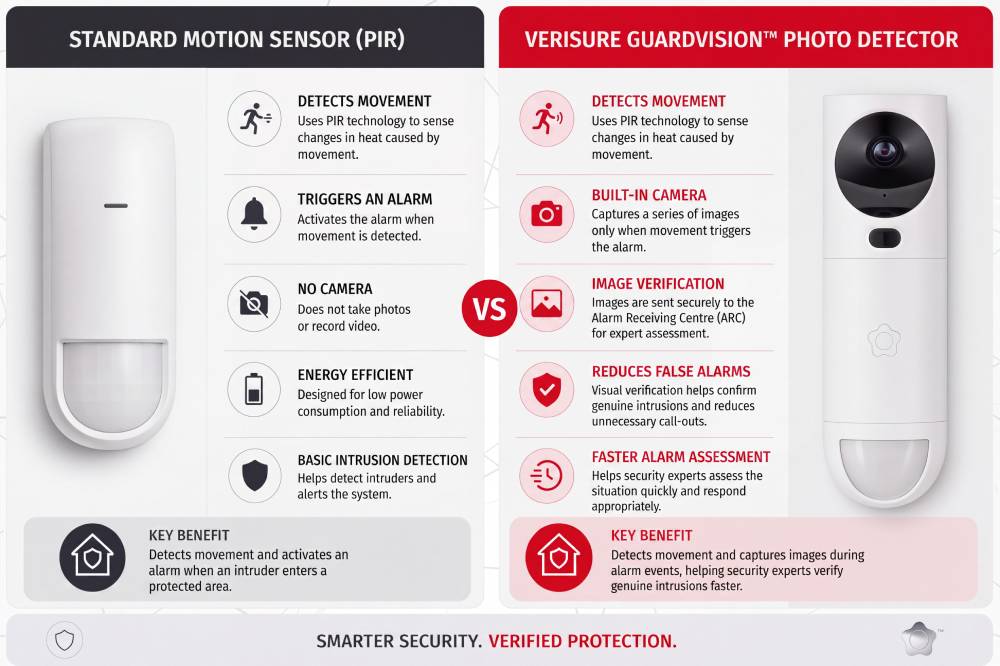
Not all motion detectors have cameras. Most motion detectors are designed simply to sense movement and trigger an alarm when someone enters a protected area. They don't take photos or record video.
That said, some advanced alarm systems combine motion detection with a built-in camera. For example, Verisure's GuardVision™ photo detector can capture a series of images when an alarm is triggered. These images are sent to the Alarm Receiving Centre (ARC), allowing security experts to quickly check whether there's a genuine break-in and respond accordingly.
By combining motion detection with image verification, homeowners benefit from faster alarm assessment, fewer false alarms and greater peace of mind.
Motion Sensor vs Camera: What's the Difference?
Although they often work together, motion sensors and security cameras perform different roles.
| Motion Sensor | Security Camera |
|---|---|
| Detects movement using infrared or other sensing technology | Captures live or recorded video |
| Does not usually record images | Continuously or event-based records footage |
| Triggers alarms when movement is detected | Provides visual evidence of activity |
| Helps detect intruders | Helps identify what caused the alarm |
How Do PIR Motion Detectors Work?
The most common type of home motion detector is a Passive Infrared (PIR) sensor.
A PIR detector works by sensing changes in heat (infrared energy) within a room. Every person, pet and warm object emits heat. When someone moves across the detector's field of view, the sensor identifies the change in infrared energy and triggers the alarm if the system is armed.
Unlike cameras, PIR sensors do not see or record images. They simply detect movement based on temperature differences.
Because they don't constantly monitor visually, PIR detectors are energy efficient, reliable and ideal for protecting hallways, living rooms and entry points.
What Types of Motion Sensors Are Available?
There are several different motion detection technologies used in home security.
Passive Infrared (PIR)
The most popular option for residential properties. Detects changes in body heat and movement.
Microwave Sensors
These emit microwave signals and measure reflections to detect movement. They are highly sensitive and are often used in commercial environments.
Dual Technology Sensors
These combine PIR and microwave technology. Both sensors must detect movement before an alarm is activated, significantly reducing false alarms.
Camera Motion Detectors
These combine a motion sensor with an integrated camera that captures images only when movement triggers the alarm. Verisure's Motion Detector Camera is an example of this technology, providing image verification during an alarm event while maintaining privacy during normal day-to-day use.
Are Motion Detector Cameras Always Recording?
No.
Unlike traditional CCTV systems, Verisure's Motion Detector Camera does not continuously record video.
Instead, the built-in camera only captures images when the PIR motion is detected. These images are securely transmitted to Verisure's Alarm Receiving Centre so trained security experts can assess the situation and determine the appropriate response.
This means your privacy is maintained while still providing visual confirmation during genuine security incidents.
Why Would You Choose a Motion Detector with a Camera?
A motion detector with a camera offers several advantages over a standard sensor alone.
Benefits include:
- Faster alarm verification
- Reduced false alarms
- Visual confirmation of an intrusion
- More accurate emergency response
- Additional peace of mind when you're away from home
Are Motion Detector Cameras Good for Privacy?
For many homeowners, camera-equipped motion detectors offer a balance between security and privacy.
Unlike continuously recording CCTV cameras, Verisure's GuardVision™ photo detector is designed to capture images only during an alarm event. This means there is no constant recording inside your home, while still allowing alarm specialists to verify whether there is a genuine intrusion.
This makes them an attractive option for homeowners who want enhanced protection without around-the-clock indoor surveillance.
Why Does Verisure Use Motion Detector Cameras?
Verisure combines PIR motion detection with image verification to provide a faster and more effective monitored security service.
When movement triggers the alarm:
- The PIR sensor detects movement.
- The built-in camera captures a sequence of images.
- The images are securely sent to Verisure's Alarm Receiving Centre.
- Security professionals assess the situation.
- If an intrusion is confirmed, the appropriate emergency response is initiated.
This verification process helps minimise false alarms while ensuring genuine break-ins receive immediate attention.
Encrypted Secure Cloud Storage
All alarm images are encrypted and stored in secure cloud storage.
